I named this newsletter “Learning That Feels Good.”
Then I spent the last week second-guessing it.
Thanks for reading. Subscribe to Learning That Feels Good for new posts.
Because here's what 15 years of watching people learn has taught me: research shows that effective learning often doesn't feel good while it's happening.
You know this if you’ve ever sat through mandatory compliance training. Sexual harassment prevention. Data privacy policies. Workplace safety procedures. Dreadful. The kind of training where you’re planning your grocery list while clicking “Next.”
And yet, three months later, when a colleague crosses a line, you remember exactly what that training said. When you’re about to forward sensitive client data, something stops you. You didn’t enjoy learning it. But you learned it.
This bothers me because my entire career has been built on making learning feel better. I believe in social-emotional learning. I believe positive learning experiences matter. I design with warmth, connection, and psychological safety in mind.
But the research keeps showing me something uncomfortable: feeling good during learning and actually learning are often opposites.
The Duolingo Paradox
Take Duolingo. People maintain 365-day streaks. They practice daily. They hit their goals. The app implements every learning science principle we know works: spaced repetition, retrieval practice, immediate feedback.
But, there are entire meme accounts dedicated to this: “Duolingo says I’m fluent. I can’t order coffee in Spanish.”
So what went wrong?
Duolingo feels good. Smooth progress. Little celebrations. You finish each lesson feeling accomplished. “I’m learning!”
But that feeling is lying.
What Your Brain Tells You vs. What Actually Sticks
Robert and Elizabeth Bjork, cognitive psychologists at UCLA, studied this for decades. They found that your brain tracks two different kinds of memory strength.
Retrieval strength: How easily you can access something right now.
Storage strength: How deeply it’s embedded for the long term.
When you complete a Duolingo lesson, retrieval strength is high. The vocabulary is fresh. You just saw it 30 seconds ago. It feels easy. You feel confident.
But storage strength? Almost nothing happened.
Because Duolingo has you retrieving vocabulary in isolation. “La manzana es roja” when you see a picture of an apple. Not constructing sentences in real-time when a waiter asks “¿Qué quieres tomar?” and you have 2 seconds to respond.
You’re practicing pattern-matching. Not language production under pressure.
The struggle isn’t productive if you’re struggling with the wrong thing.
The Feeling Is Lying to You
A 2019 Harvard study demonstrated this brutally. Students were randomly assigned to two physics classes: passive lectures versus active learning exercises.
The active learning students scored higher on tests.
But they rated the experience lower. They said they learned less.
They learned more. They felt like they learned less.
The researchers called it a “strong anti-correlation between feeling of learning and actual learning.”
The students preferred lectures because they felt smoother. But smooth doesn’t mean effective.
This is the trap: We mistake “this feels easy right now” for “I’ve learned this.” Easy often just means “I saw this 30 seconds ago.”
Why That Boring Compliance Training Actually Worked
Back to that data security training you found tedious.
It probably worked because of spacing (you saw the content once, then encountered the situation months later), retrieval practice (you had to make a decision in the real moment), and context variation (the real situation never matched the training scenario exactly).
All the things that make learning stick. None of them felt good.
Research on workplace training backs this up. Baldwin and Ford’s framework on transfer identified three factors that determine whether training changes behavior:
Do you think it matters?
Does it include practice, not just information?
Does your manager support applying it?
Notice what’s missing: “Did you enjoy it?”
Gallup found only 23% of employees rate compliance training as “excellent.” Most find it uninspiring. But meta-analyses show properly designed training produces behavior change, when it includes practice, spacing, and post-training support.
It can be boring. It can still work.
But it cannot be passive. That’s the line.
Earned Satisfaction Comes Later
When I say “Learning That Feels Good,” I don’t mean the dopamine hit of completing a gamified module with confetti animations.
I mean the moment three months later when you’re in a meeting and someone asks, “How should we handle this?” and you realize: you know. You actually know.
Not because you memorized it yesterday. Because you learned it months ago and it stuck.
That feeling, the earned satisfaction of learning that changed how you work, doesn’t happen during the training. It happens when the need emerges.
You struggled through that module. It felt like a waste of time. But when the situation arose, the knowledge was there.
That’s when it feels good. Not before.
The Bjorks call this the difference between performance (how you feel during learning) and learning (what you retain long-term). Performance can be high while learning is low. Learning can be high while performance feels low.
We measure the wrong one because performance is what we can see during training. Learning only reveals itself later.
The False Satisfaction Problem
This is what keeps me up at night as I build inspaire.
You complete a beautifully designed module. Smooth interactions. Immediate feedback. Confetti at the end. “Congratulations! You’ve completed Leadership Fundamentals!”
You feel accomplished.
Two weeks later, your manager asks you to apply one concept from that training. You remember nothing.
The smooth experience created retrieval strength (you could answer questions while content was right in front of you) but not storage strength (you can’t access it when you actually need it).
The learner feels satisfied. The company checks the compliance box. But no learning happened.
This is the challenge every EdTech builder faces:
How do you design learning that feels productive while actually being productive?
Because here’s what the research shows: when learners understand why something is difficult (transparent difficulty), and when the challenge is calibrated correctly (hard but achievable), productive struggle can feel satisfying.
The problem is most EdTech optimizes for immediate satisfaction without the learning. Or it creates difficulty without explanation, so learners think the product is broken.
The goal isn’t to make learning feel bad. It’s to make productive difficulty feel purposeful.
What Actually Matters When You’re Evaluating Learning Products
When you’re buying an EdTech tool or designing one, here’s what matters more than “Does this feel good?”:
Does it require retrieval, not just recognition? (Recalling information without seeing it first, not just clicking the right answer from a list)
Does it space practice over time? (Revisiting concepts at increasing intervals, not cramming everything into one session)
Does it demand application in context? (Using knowledge to solve real problems, not just answering quiz questions)
Does it explain why the difficulty matters? (Transparent difficulty builds trust: “We’re spacing this because research shows...”)
Can you measure retention, not just completion? (What percentage can still apply this 30 days later?)
Here's the pattern:
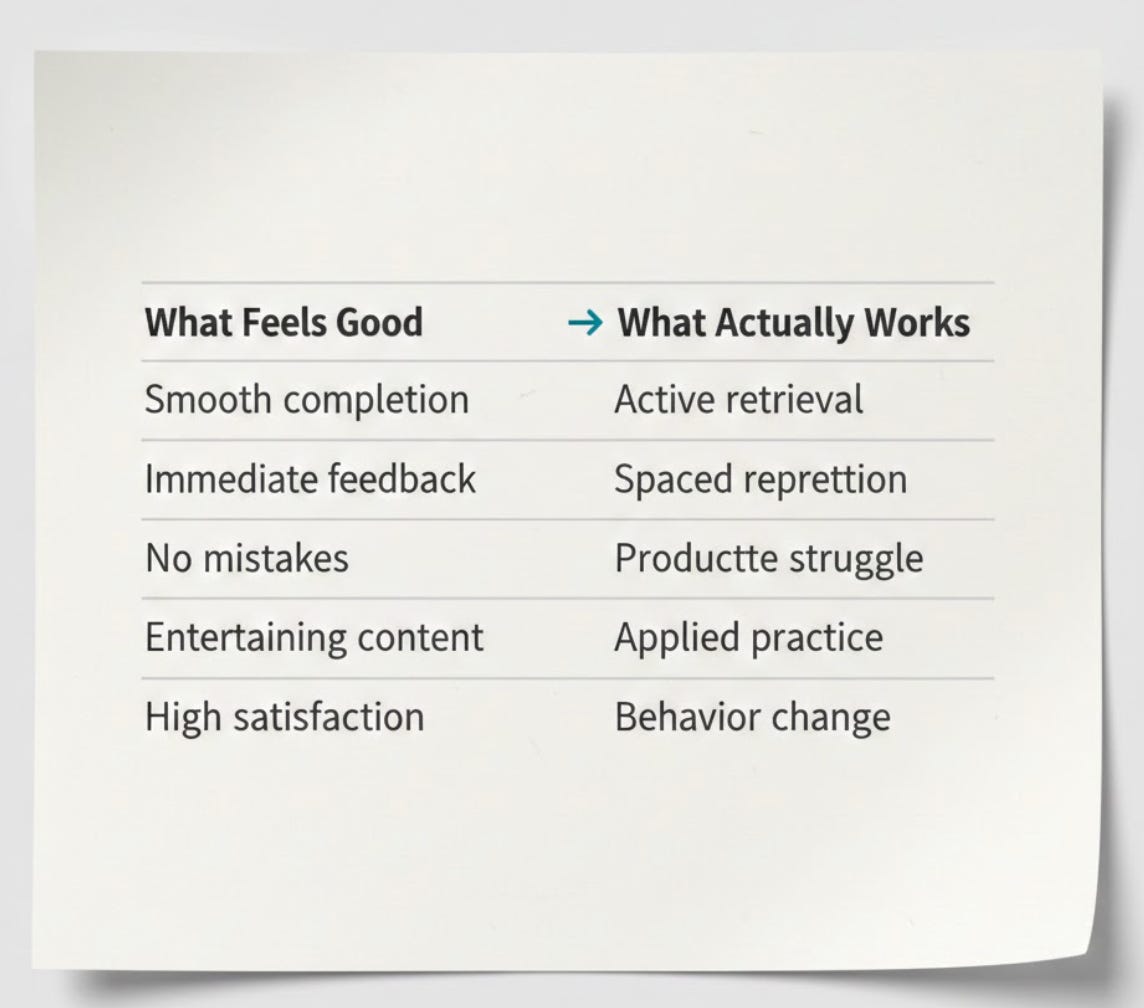
The left column is easier to sell. The right column produces learning.
The best products find ways to do both. But when forced to choose, they choose effectiveness over enjoyment.
This Is What I’m Teaching
In my free 30-minute Maven Lightning Lesson, Design AI-Powered EdTech: Learning Science Foundations, I’m teaching the framework to translate learning science principles into product features.
One example: How do you implement spaced repetition in a way that actually works (builds storage strength) without users thinking your product is broken?
Because here’s the thing: You can build productive difficulty into your product. But if users don’t understand why it’s there, they’ll abandon it.
The design challenge is this: How do you build features that implement learning science (even when it feels harder) while helping users trust that the difficulty is productive?
The Lightning Lesson gives you the core framework. If you’re building EdTech, evaluating vendors, or frustrated that your company keeps buying learning products that don’t produce learning, join me!

In the full 4-week course (Building EdTech That Works: Learning Science + AI), we go deeper: prioritizing which principles matter for your product, handling conflicts between principles, measuring learning efficacy instead of engagement, and knowing when AI actually helps versus when it’s marketing theater.
The Uncomfortable Truth
Learning that works does not often feel good while it’s happening.
The compliance training was tedious. The retrieval practice felt like failing. The spacing felt inconvenient.
But months later, when you needed that knowledge, it was there.
As an EdTech builder, I can’t promise users will love every moment. But I can design for the moment three months later when they realize: this actually stuck.
That’s the feeling I’m after. Not the dopamine hit of clicking “Complete.” The quiet confidence of knowing something when it matters.
Maybe that’s what “Learning That Feels Good” really means.
Not learning that feels effortless.
Learning that feels earned.
If you’ve ever finished training and forgotten it immediately, or struggled through something that somehow stuck please hit reply. I want to hear about it!
Thanks for reading. Subscribe to Learning That Feels Good for new posts.