From Classroom to Boardroom: The Untold Story of Educators in Corporate L&D
I never thought I’d write this sentence: After 15 years in higher education, I now call myself an L&D professional. For years, I introduced myself as...
I never thought I’d write this sentence: After 15 years in higher education, I now call myself an L&D professional.
For years, I introduced myself as “Ilkem, I teach at Sabancı University.” My identity was wrapped in academia, the research projects, the conference presentations, the satisfaction of watching students transform from uncertain freshmen to confident graduates ready to change the world.
Then I moved to the Netherlands. And suddenly, that identity didn’t quite fit anymore.
The transition wasn’t smooth. It wasn’t a LinkedIn post celebrating a “new chapter.” It was messy. It was doubt-filled questions at 2am: “Am I qualified for this?” “Will they see my academic experience as valuable or irrelevant?” “How do I even translate ‘coordinated academic programs for 500+ students’ into corporate language?”
But here’s what I’ve learned: The skills that made me effective in higher education are exactly what make me effective in corporate L&D. And I’m not alone, thousands of educators are discovering this, even as they battle imposter syndrome and navigate a transition that feels like learning a new language.
This article is for you if you’re an educator wondering “what’s next?” And it’s for L&D hiring managers who might be overlooking the talent pipeline hiding in academia.
The Imposter Syndrome Trap: Why Educators Don’t See Their Own Value
Here’s the pattern I experienced, and I see it replicated in conversations with educators everywhere:
I applied for jobs thinking “I don’t have X credential.” I downplayed 15 years of program design as “just teaching.” I assumed the corporate world needed MBAs, not an MA in Cultural Studies. I didn’t realize that managing teams of 30+ facilitators was people management. I felt like “instructional design” was some mysterious corporate skill, not what I’d been doing every single day for over a decade.
The research shows I’m not alone. Taylor Franks, an instructional designer who transitioned from teaching high school, describes the moment a company asked for a work sample: “I panicked. I had hundreds of work samples, but I didn’t have any material that would be relevant to an engineer.”
She had the work samples. She just didn’t see their relevance.
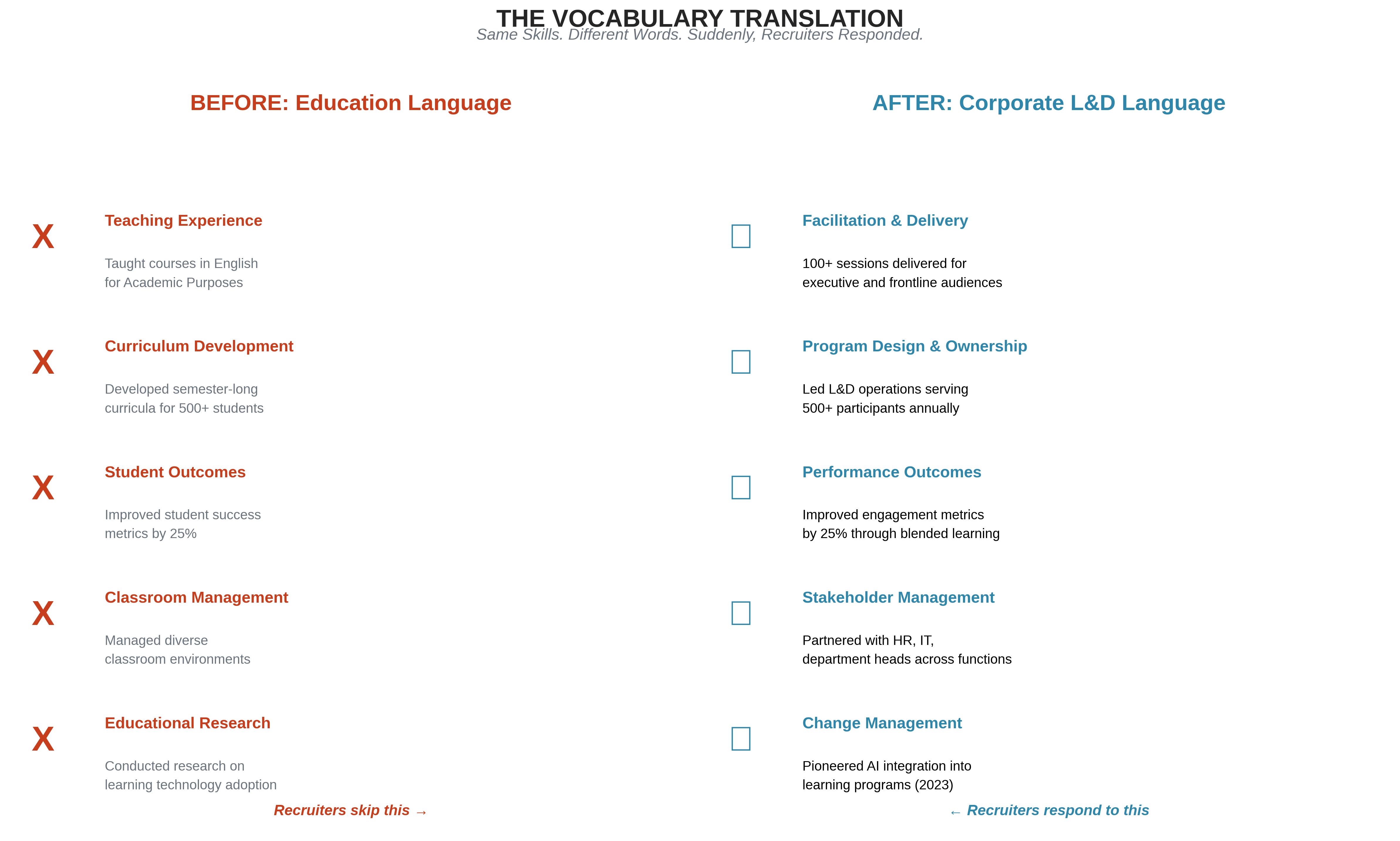
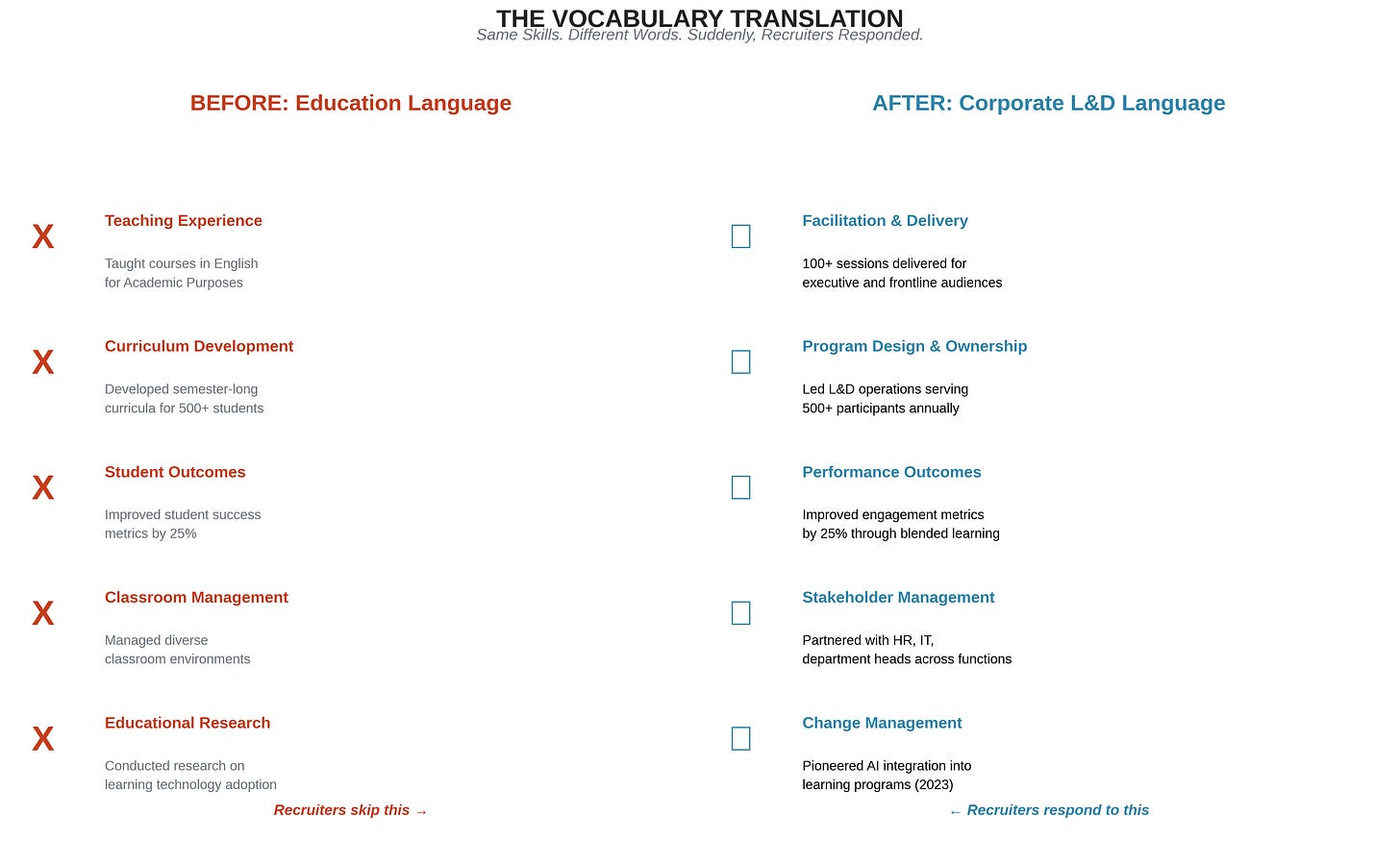
This is the gap. Educators possess skills that are, according to multiple industry reports, “second nature to experienced educators”, but we don’t recognize them. We see “lesson plans” where the corporate world sees “learning experience design.” We say “curriculum development” when they need to hear “program design and delivery.” We think “student outcomes” instead of “performance outcomes.”
Same skills. Different vocabulary. And that vocabulary gap costs talented educators opportunities they’re absolutely qualified for.
So let me translate. Here’s what actually transfers, backed by research across Training Industry, Reworked, and Devlin Peck’s extensive analysis of educator transitions:
Learning science mastery. We understand repetition, assessment, scaffolding, cognitive load. This isn’t something we learned from a certification, it’s woven into how we think about teaching.
Rapid problem-solving. Managing diverse learners, adapting in real-time when a lesson isn’t landing, pivoting when technology fails mid-presentation. In my case at Sabanci: designing courses for 500+ students with vastly different needs, backgrounds, and goals.
Stakeholder management. In higher education, I partnered with HR, IT, and department heads to align learning solutions with organizational priorities. I built evidence-based cases for new initiatives. I navigated organizational politics to get buy-in for change. That’s exactly what corporate L&D professionals do, just with different stakeholders.
Program design at scale. We don’t just create one lesson. We design semester-long curricula with measurable outcomes, assessment checkpoints, and iterative improvements based on data. That’s program management.
Facilitation mastery. By the time I transitioned, I had facilitated 100+ sessions. Some for executives, some for frontline staff, some for mixed audiences. I learned to read the room, adapt my approach mid-session, and ensure everyone left with something actionable. That’s what corporate trainers do.
Change management. When I pioneered AI integration into learning programs at Sabancı in 2023, I didn’t just announce it. I built cases, addressed concerns, ran pilots, trained colleagues. That’s organizational change leadership.
When I finally rewrote my CV with L&D language, I didn’t change what I did. I just changed how I described it. “Coordinated academic programs” became “Led L&D operations serving 500+ participants annually.” Same work. Different words. Suddenly, recruiters responded.
What Higher Education Taught Me That Corporate L&D Desperately Needs
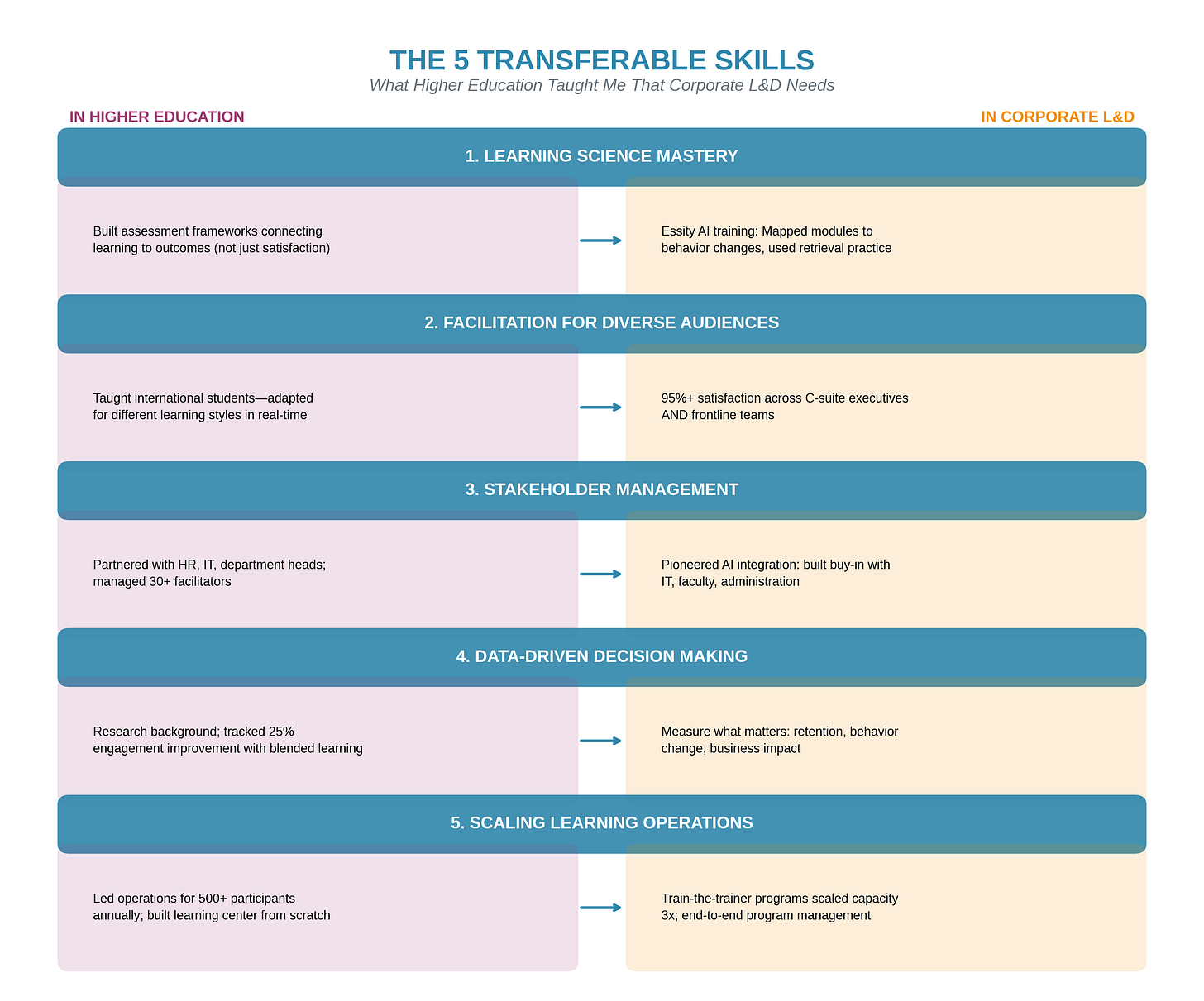
Let me get specific. Here are five skills I brought from higher education that have proven invaluable in corporate L&D, with concrete examples from my work.
1. Designing Learning Experiences That Stick (Not Just Engagement Theater)
In 15 years, I learned the difference between what produces learning and what looks impressive. I built assessment frameworks that connected learning activities to actual outcomes, not just completion rates or satisfaction scores. My research background and Cambridge certification in AI-Powered Learning Science validated what I already knew: engagement metrics are vanity metrics. What matters is retention, transfer, and behavior change.
When I designed the multi-module AI training for Essity sales leadership, I didn’t just create slides. I mapped each module to specific behavior changes we needed to see in client conversations. Then I built retrieval practice checkpoints, spaced the modules deliberately, and iterated based on real-time feedback from participants across sessions.
That’s not “teaching”, that’s evidence-based instructional design. But I learned to do that in academia.
Corporate L&D desperately needs people who understand the science of learning, not just the performance of learning. We’ve been doing that work for years. We just need to name it correctly.
2. Facilitating for Diverse Audiences (The Real Adaptive Learning)
I spent years teaching English for Academic Purposes to international students. That meant I had to explain complex grammar to someone who thought in Turkish syntax, then pivot to help a native English speaker unlearn bad habits, then support a visual learner who needed diagrams, all in the same 90-minute session.
Now I facilitate corporate workshops. I’ve worked with C-suite executives at Stellantis and frontline sales teams at Essity. The content changes. The adaptive facilitation skills? Those are muscle memory.
I consistently achieve 95%+ satisfaction scores across wildly different audiences, not because I’m naturally charismatic, but because I learned over 15 years how to read a room, diagnose confusion in real-time, and adjust my approach on the fly. That’s what corporate trainers need to do. And we’ve been doing it longer than most corporate trainers have been in the profession.
3. Managing Stakeholders Across Silos (The Unsung Superpower)
Here's what nobody tells you about higher education: it's stakeholder management boot camp.
4. Data-Driven Decision Making (Not Gut Feelings)
My research background in qualitative methods and policy analysis taught me how to build strong, data-informed arguments. At Sabancı, I couldn't just say "students liked the workshop." I had to show: Did they retain the information 30 days later? Did they apply it in their thesis work? Did performance metrics improve?
5. Scaling Learning Operations (The Systems Thinking Advantage)
When I built the learning center at Istanbul Bilgi University from scratch, I wasn't just "teaching." I designed the service model. I built operational processes. I trained and certified 15 peer facilitators to ensure consistent quality. I integrated with five different departments. I grew it from concept to 300+ active users annually.
What They Don’t Tell You About the Transition (And What Actually Helps)
I want to be honest about what's hard. Not to discourage you, but to prepare you. The transition is real. But it's navigable if you know what you're facing.
Challenge #1: The Language Barrier
This was the first wall I hit. "Learning objectives" versus "business objectives." "Curriculum development" versus "program design." "Student outcomes" versus "performance outcomes."
Challenge #2: The Business Acumen Gap
I'm honest about this: I didn't know what "quarterly targets" meant in a corporate context. I didn't immediately understand P&L implications or how to speak to productivity metrics as KPIs. Research confirms this is a common gap: "An understanding of business objectives, metrics and organizational priorities is crucial to align L&D initiatives with broader company goals. Educators may need to learn how to connect training outcomes to business performance indicators."
Challenge #3: The Culture Shock
This was the hardest shift for me. In academia, I could spend 15 weeks building deep understanding. Students could sit with complexity, wrestle with ambiguity, develop nuanced thinking.
Challenge #4: The Imposter Syndrome (It’s Real, and It’s Lying to You)
After facilitating my first corporate workshop, I apologized to the client. "Sorry if that wasn't polished enough, this is new for me."
To Educators Considering the Leap, and to Companies Who Should Be Hiring Them
To Educators:
Reframe your experience in their language. Use corporate L&D job postings as your Rosetta Stone. “Facilitation” not “teaching.” “Program design” not “curriculum development.” “Stakeholder management” not “faculty coordination.” The work is the same. The words are different.
Build bridges, not walls. Take one course to learn corporate L&D frameworks (ADDIE, SAM, you already do this intuitively, you just need the labels). Get your ICF coaching certification if it boosts confidence. Join LinkedIn L&D groups and absorb the language. Find one mentor already in corporate L&D. I’ll be yours if you need one.
Own your expertise. You’re not a “former teacher trying to break into L&D.” You’re an “L&D professional with 15 years designing learning experiences in higher education.” The skills are the same. The context is different. You’re not starting over.
Start before you’re ready. Volunteer to lead professional development at your current institution. Offer to design onboarding for new hires. Build a portfolio with what you already have, lesson plans ARE work samples. Don’t wait for permission. Your experience counts now.
To L&D Hiring Managers:
Look beyond the resume keywords. “10 years teaching experience” equals 10 years designing learning experiences. “Managed 50 instructors” equals people management at scale. “Research background” equals data-driven decision making. Stop filtering out educators because they don’t say “ADDIE.” They do ADDIE. They just call it something else.
Recognize the hidden advantages. Educators have learning science in their bones. You might have to train a business person on cognitive load theory, educators live it. They’ve facilitated 1000+ hours. (Your average corporate trainer has facilitated 100.) They adapt in real-time. They’ve been managing diverse learners, building assessments that matter, and iterating based on data longer than most corporate L&D professionals have been in the field.
Provide transition support. Offer “corporate language” onboarding. Pair them with a business-savvy mentor. Give them time to learn your KPIs and metrics. The ROI is worth it, educators are loyal, committed to excellence, and intrinsically motivated by learning outcomes, not just performance reviews.
Stop requiring “5 Years Corporate L&D Experience.” You’re eliminating the best facilitators, designers, and learning scientists from your pipeline. Require “5 years designing and delivering learning experiences” instead. The context changes. The skills transfer.
Where We Go From Here
If you’re an educator reading this and thinking “maybe I could do this,” the answer is yes. Not “someday.” Not “after I get certified.” Yes, now.
Your experience teaching, facilitating, designing, iterating, managing, measuring, it all counts. The transition is real, but so are your skills.
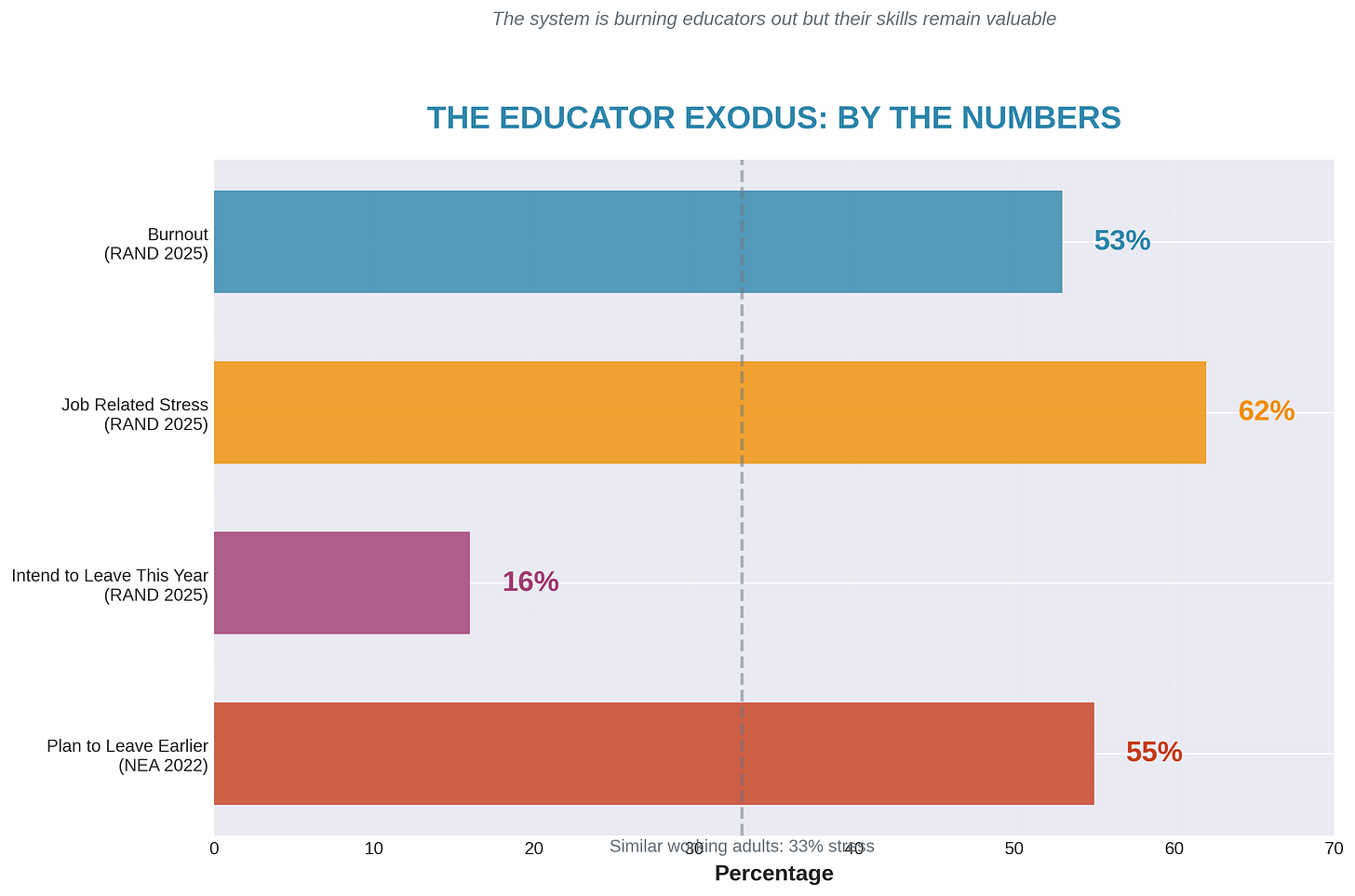
The data is sobering: 55% of educators planned to leave earlier than anticipated (NEA 2022). 16% intend to leave by the end of this school year (RAND 2025). 62% report frequent job-related stress compared to 33% of similar working adults (RAND 2025). The system is burning people out. But the skills you developed in that system? They’re not wasted. They’re valuable.
I’m here. Find me on LinkedIn. Ask questions. Share your wins and your doubts. We’re building a community of educators who refused to let expertise go to waste.
The corporate world needs what we have. They just don’t know how to find us yet. Let’s make it easier for them.
For L&D leaders: The next great facilitator on your team might currently be coordinating academic programs at a university. The next learning architect might be running a study skills center. The next L&D director might be managing faculty development programs.
They won’t use your keywords. But they have your skills. And they’re looking for a place where their expertise is valued, their work-life balance is sustainable, and their impact is measurable.
Hire an educator. I promise you won’t regret it.
Ilkem Kayican Dipcin is an L&D professional with 15 years of experience designing and facilitating learning journeys. She currently works as a Learning & Development Consultant, delivering AI transformation training for organizations across EMEA. She is also the Founder & CEO of InspAIre, an AI-powered instructional design platform. Connect with her on LinkedIn.