I taught a Lightning Lesson this week on designing AI-powered EdTech, and someone asked a question that perfectly captures why most EdTech fails:
“Can spaced repetition and constructive feedback work together in the same product, or do they conflict?”
Thanks for reading. Subscribe to Learning That Feels Good for new posts.
The question itself reveals the deeper problem: we’ve been conditioned to think learning science principles exist in isolation, pick one, optimize for it, ship it. We assume if the technology is smart enough, it automatically brings learning together.
It doesn’t work that way. And it never has.
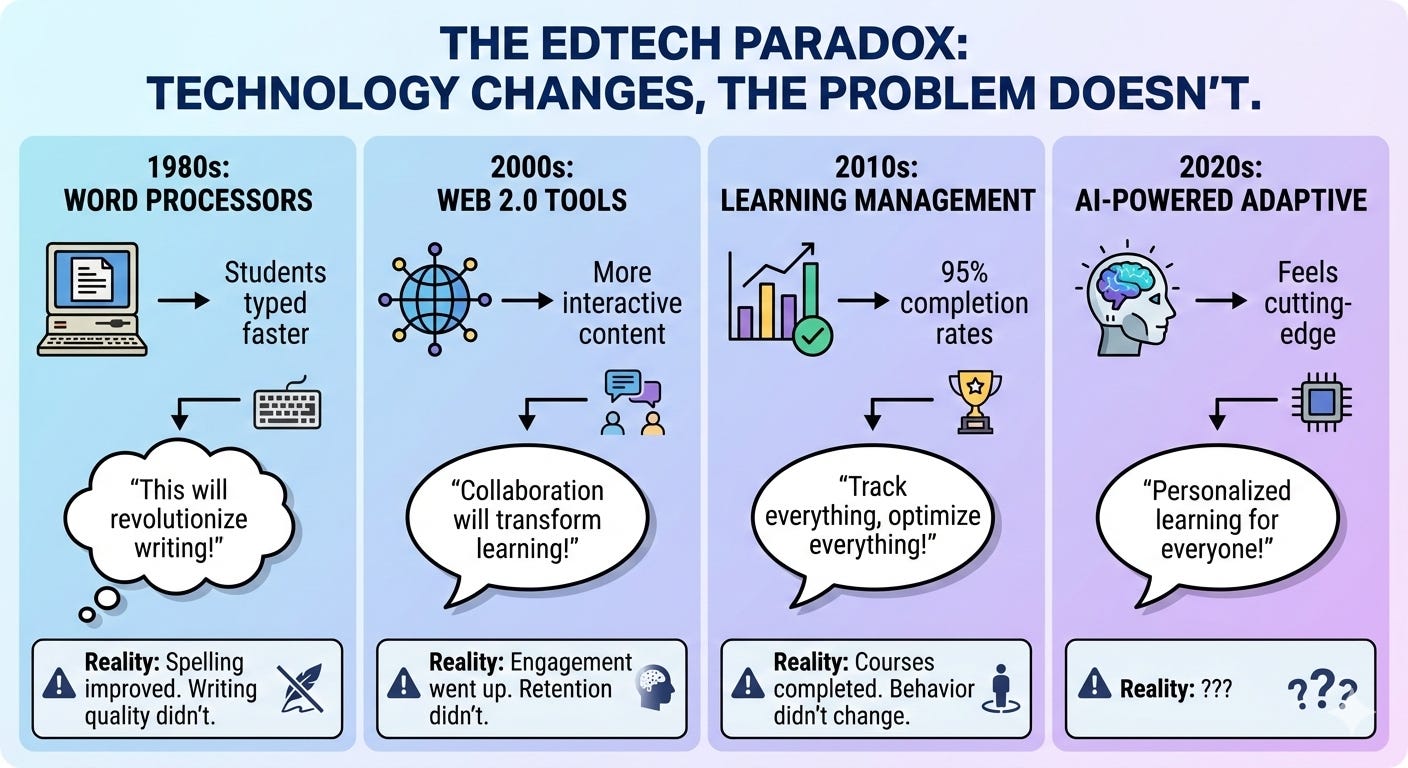
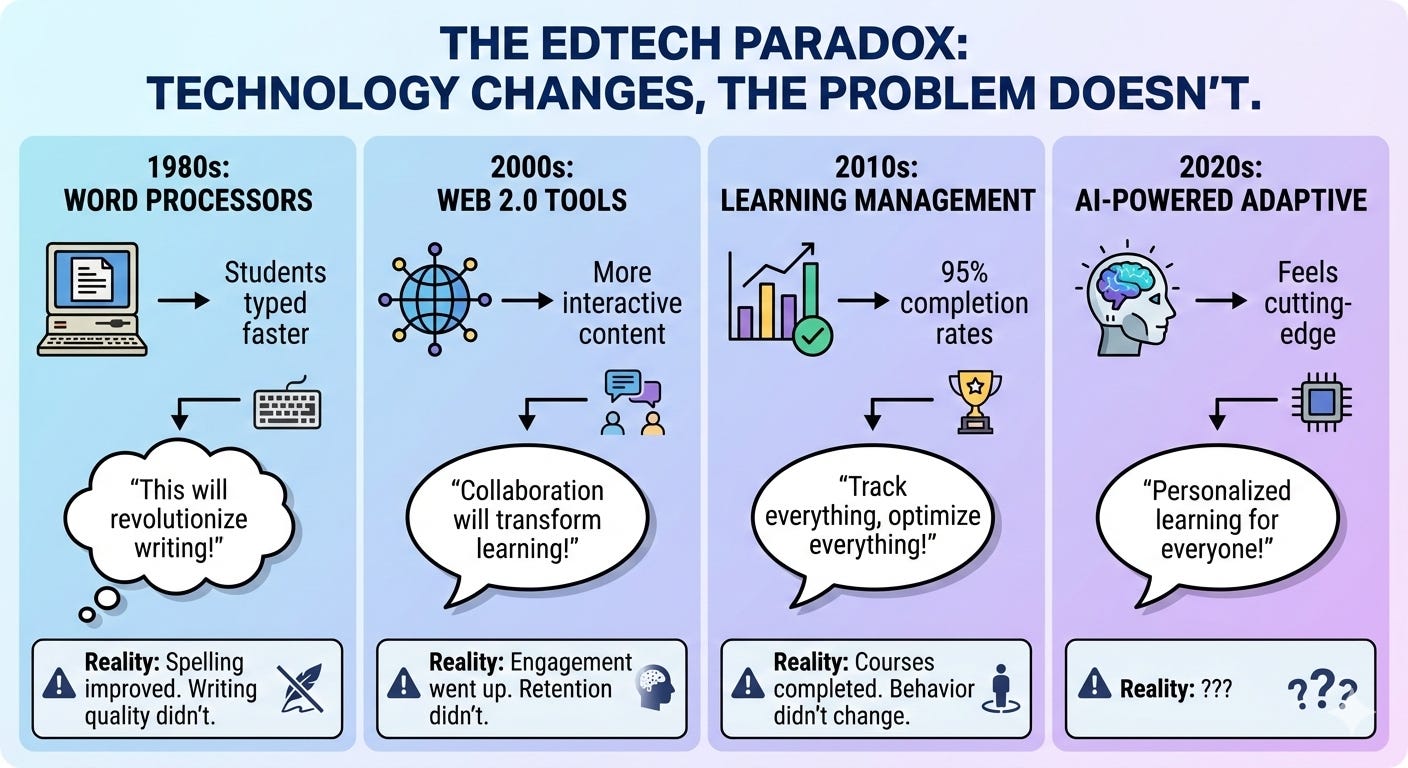
Every decade, the same pattern: We optimize for what the TECHNOLOGY can do, not for what LEARNING requires.
What Actually Produces Learning (According to Science, Not Hype)
Here’s the paradox that breaks most EdTech products:
What feels good during learning ≠ What actually works long-term.
Smooth completion ≠ Deep understanding
Immediate feedback ≠ Long-term retention
High satisfaction scores ≠ Behavior change
Zero mistakes ≠ Mastery
Research calls this “desirable difficulties” (Bjork & Bjork, 1992). When learning feels effortless, you’re often just building familiarity. You can recognize information when you see it, but you can’t recall it when you need it.
Example: Duolingo users maintain 365-day streaks but still can’t order coffee in Spanish.
Why? Duolingo actually implements spaced repetition correctly, they published research on their Half-Life Regression algorithm. Sophisticated implementation.
But they’re having you retrieve vocabulary in isolation, not produce language under real conversational pressure. The learning science is there. The implementation is sophisticated. But it’s applied to pattern-matching, not the actual skill users want: speaking.
This is the gap: You can implement a principle perfectly and still fail if you don’t understand what outcome you’re building for.
The Framework That Bridges Learning Science and Product
After 15 years building learning products and consulting with Fortune 500 companies, I developed a 5-step framework that translates research into features engineers can actually build.
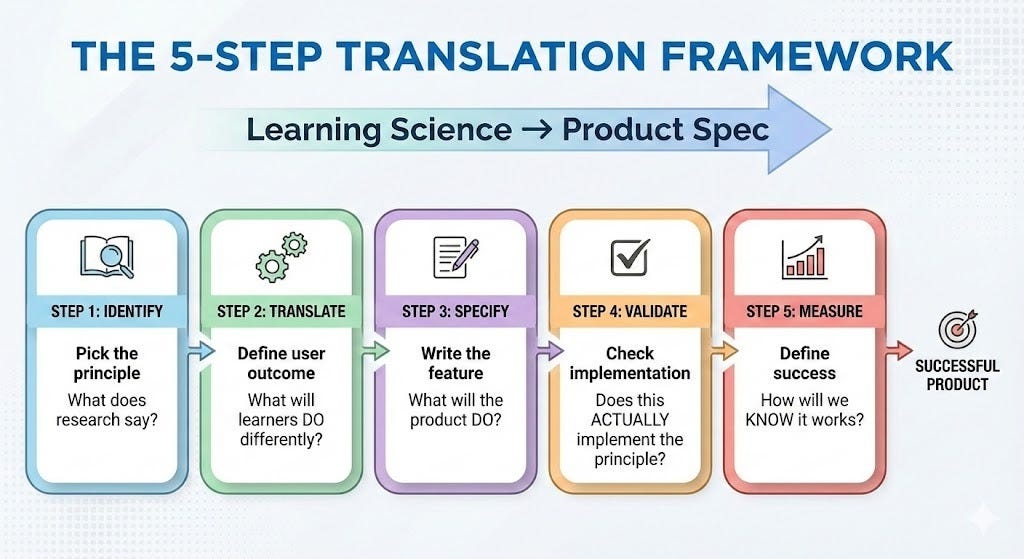
STEP 1: IDENTIFY
Pick the principle. What does research actually say?
Not “engagement”, that’s not a principle. Spaced repetition, retrieval practice, cognitive load management, those are principles backed by decades of research.
STEP 2: TRANSLATE
Turn research into behavior. Be specific.
Bad: “Spaced repetition improves retention”
Good: “Learners review concepts at Day 1, 3, 7, 14, 30”
STEP 3: SPECIFY
Write the feature with acceptance criteria.
Not vague: “System helps learners remember”
Specific: “System schedules review notifications at these intervals. User can’t skip to next concept without completing review. System explains: ‘Research shows spacing improves retention by 40%’”
STEP 4: VALIDATE
Does this ACTUALLY implement the principle?
Most products fail here. They claim “AI-powered adaptive learning” but can’t explain what principle the AI implements. If you can’t explain which learning science principle your feature implements, you’re not implementing learning science. You’re implementing features and hoping they work.
STEP 5: MEASURE
Define success. What learning outcome changes?
Wrong: Engagement, time on platform, completion rates
Right: 30-day retention, behavior change, application on the job
Live Example: Spaced Repetition Done Right (And Why Feedback Fits)
Let me show you how this works in practice, and answer that question about spacing and feedback.
The Principle: Ebbinghaus Forgetting Curve (1885). Without review, learners lose 75% of information within 6 days. Spaced repetition fights this by reviewing at increasing intervals.
The Translation:
Learners review material at: Day 1, 3, 7, 14, 30
The Feature Spec:
System tracks last review date per concept
Notification triggers when interval reached
User attempts recall BEFORE seeing answer (retrieval practice)
System provides feedback AFTER attempt
Transparency: “Reviewing this now because you missed it last time, research shows spacing improves retention by 40%”
Here’s where feedback comes in: Spaced repetition and immediate feedback don’t conflict. They serve different purposes.
Spaced repetition = When to review (timing based on forgetting curve)
Feedback = What to do after retrieval (error correction and motivation)
The magic is in the sequence:
Spacing determines WHEN the system prompts review
Retrieval practice happens (learner attempts without hints)
Feedback happens AFTER the attempt (not before)
System explains WHY to build trust
The Validation:
✓ Intervals increase over time (implements spacing)
✓ Based on Ebbinghaus curve (grounded in research)
✓ Requires active retrieval (not passive review)
✓ Explains reasoning to users (transparency builds trust)
The Measurement: Primary: 30-day retention test
Compare: Spaced group vs. massed practice group
Target: 40% improvement in retention
Not engagement. Not satisfaction. Retention.
What Happens When You Add AI
Basic spaced repetition with fixed intervals works. You don’t NEED AI.
AI becomes valuable when you want personalization: some learners need 2 days for a concept, others need 5 days.
What AI Should Do:
Track retrieval success per learner per concept
Student struggles with Concept X → shorten interval (3 → 2 days)
Student masters Concept Y → lengthen interval (7 → 10 days)
Tell the user: “Reviewing this sooner because you missed it last time”
The Critical Difference:
Basic = One size fits all, same intervals for everyone
AI = Adapts to individual forgetting patterns
BOTH require understanding the principle first.
Here’s what most EdTech gets wrong: They skip the basic implementation and jump straight to “AI-powered adaptive learning” without understanding what the AI should adapt, based on what principle, measured by what outcome.
The Business Impact Nobody Talks About
When companies actually implement learning science correctly, the results are measurable:
Walmart Logistics deployed microlearning with spaced repetition to 75,000 distribution center workers:
54% reduction in safety incidents (6-month pilot across 8 centers)
50%+ reduction in lost-time injuries (3-year implementation)
91% voluntary participation (not required, employees wanted to use it)
Millions in savings from reduced workers’ compensation costs
Bloomingdale’s implemented the same approach for 10,000 retail associates:
41% reduction in safety claims
$3 million in verified savings in one year
90% voluntary participation rate
These aren’t engagement metrics. These are P&L impacts.
Meta-analysis data (Adesope et al., 2017, analyzing 188 experiments):
Retrieval practice outperforms restudying: effect size g = 0.51
Retrieval practice vs. no activity: effect size g = 0.93
An effect of 0.50 moves a learner from the 50th to the 69th percentile. In corporate training terms, that’s the difference between acceptable performance and top-quartile performance.
The Reality Check: AI-Powered vs. Snake Oil
After 15 years evaluating EdTech products, here’s my framework for separating real learning science from marketing theater:
🚩 RED FLAGS (Run away):
“AI personalizes your learning” with no specifics on HOW
Claims “adaptive” but can’t explain adaptation logic
Measures engagement, not retention
No mention of underlying learning principles
“Powered by machine learning” (so what? To do WHAT?)
✅ GREEN FLAGS (This might be legit):
Names the learning science: “Our AI implements spaced repetition, reviewing material at increasing intervals so learners retain more long-term”
Explains HOW AI makes decisions: “Tracks which concepts each learner struggles with and adjusts practice timing”
Provides transparency to users: “We’re showing you this now because you missed it last time”
Measures learning outcomes: “30-day retention improved by 40% vs. traditional training”
Works without AI too: “Basic version uses fixed intervals. AI personalizes timing per learner”
Why This Matters for Your Business
If you’re an EdTech founder:
Founders who can explain “Our system tracks which concepts each employee struggles with and schedules targeted practice, so they reach competency 30% faster” close enterprise deals 3x faster than those who say “We use AI to personalize learning.”
Because the first one connects to an outcome a CFO will pay for. The second is just buzzwords.
If you’re an L&D professional:
Your training budget is too expensive to waste on products that optimize for the wrong metrics. The Netherlands just released an official EdTech evaluation framework (3E Framework, 2025) with three evidence levels: Bronze, Silver, Gold.
Most “AI-powered” platforms? They don’t even have Bronze level, no logic model, no theory, just marketing.
Demand evidence. Demand explanations. Demand outcomes.
If you’re evaluating or building EdTech:
The corporate training market wastes an estimated 75% of its $1,283 per-employee annual spend because forgetting destroys retention without reinforcement. Research shows learners retain only 25% after 6 days and 10-13% after 30 days without spaced practice.
That’s $900–1,000 per employee per year, completely wasted.
Learning science-based products directly attack this waste. It’s not a feature, it’s a defensible business moat.
The Three Takeaways
1. The Gap Between “Feels Good” and “Actually Works”
Most EdTech optimizes for smooth user experience and high engagement. Effective learning often requires productive struggle. Your job is to build features that implement learning science even when they feel harder, and explain WHY the difficulty matters.
2. The 5-Step Translation Framework
Whether you’re building EdTech or evaluating vendors: (1) Identify the principle, (2) Translate to user behavior, (3) Specify the feature, (4) Validate it implements the principle, (5) Measure learning outcomes, not engagement.
3. “AI-Powered” Without Learning Science Is Just Marketing
You can’t sell, or build, what you can’t explain. Learning science gives you the language to sell outcomes, not algorithms.
What Now?
The EdTech market is crowded with products that feel impressive but don’t work. There’s a massive opening for products that implement actual learning science and can prove they produce business outcomes.
The research is clear. The business case is documented. The frameworks exist.
What’s missing isn’t the technology. It’s the understanding of how learning actually works.
And that understanding is what separates EdTech that closes deals from EdTech that gets ghosted after the demo.
I’m teaching a 4-week cohort course starting in March: Building EdTech That Works: Learning Science + AI
Whether you’re building products or evaluating vendors, you’ll learn:
All 5 learning science principles (not just spacing)
How to apply the framework to YOUR product
When AI adds value vs. when it’s theater
How to measure outcomes that justify ROI
Course details and enrollment →
Use code AIEDTECH for 20% off
What’s your experience with “AI-powered” EdTech? Have you asked vendors these questions? What did they say? Drop a comment below, I read and respond to every one.
References:
Adesope, O. O., Trevisan, D. A., & Sundararajan, N. (2017). Rethinking the use of tests: A meta-analysis of practice testing. Review of Educational Research, 87(3), 659-701.
Bjork, R. A., & Bjork, E. L. (1992). A new theory of disuse and an old theory of stimulus fluctuation. In From learning processes to cognitive processes: Essays in honor of William K. Estes (Vol. 2, pp. 35-67).
Dutch 3E Framework (2025). Evidence-informed Evaluation of EdTech. DOI: 10.5281/zenodo.15070789 https://npuls.nl/en/knowledge-base/dutch-3e-framework-evidence-informed-evaluation-of-edtech
Thanks for reading. Subscribe to Learning That Feels Good for new posts.